


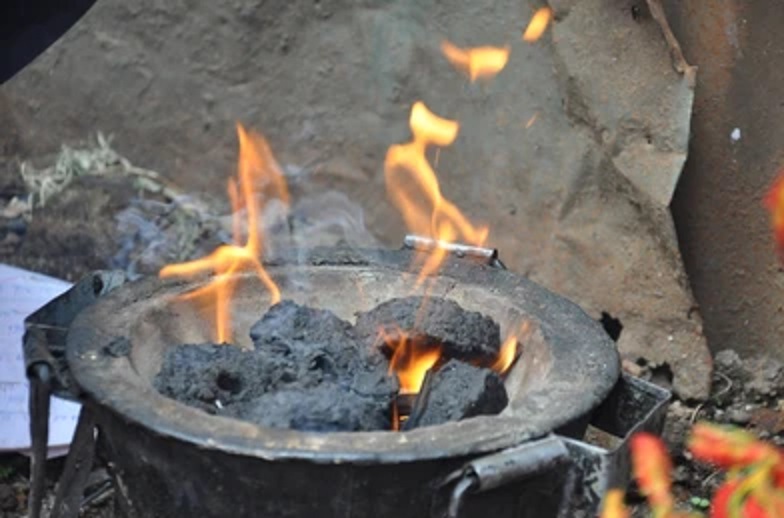
HARDSHIP: Nigerians dump cooking gas for charcoal, firewood as prices skyrocket
The Nigerian Association of Liquefied Petroleum Gas Marketers (NALPGAM) has raised the alarm over the persistent surge in the price of Liquefied Petroleum Gas (LPG), warning that the development could trigger widespread public dissatisfaction if the federal government fails to intervene urgently.
Marketers are currently grappling with severe supply constraints, soaring depot prices, logistics bottlenecks, and rising operational costs. According to NALPGAM, a 20-metric-tonne truck of LPG now costs between ₦25.2 million and ₦26.2 million depending on the location, heavily driving up retail prices across the federation.
The association lamented that the price hike has imposed severe economic hardship on households, food vendors, and small businesses. It warned that many families are being forced to abandon clean energy for traditional fuels like firewood and charcoal, a shift that threatens to reverse years of progress made in promoting cleaner and safer cooking alternatives.
READ ALSO: Nigeria bans exportation of cooking gas to reduce price
Across the States: Nigerians share their survival strategies
A nationwide investigation reveals that families across Nigeria’s geopolitical zones are quickly adapting to the harsh economic realities by cutting down on gas usage.
Kaduna
In Kaduna State, residents have resorted to strict rationing. Maimuna Sani, a mother of two, stated that she now uses gas exclusively on weekday mornings to prepare breakfast quickly for her school-bound children.
“On weekends, I rely on charcoal. With just ₦200 to ₦500 worth of charcoal, you can prepare a meal, unlike gas. To be honest, charcoal is more economical,” she said, noting she spent ₦14,000 to refill her cylinder at ₦1,200/kg a month ago.
Other residents, like Badamasi Isa Adamu and Bello Idris, echoed similar sentiments, stating that gas is now strictly reserved for boiling water, while charcoal handles the heavy cooking. Idris lamented paying ₦1,600/kg recently, calling it a massive financial strain.
Kano
In Kano, where retail prices have jumped from ₦1,100 to between ₦1,500 and ₦1,550 per kilogram within a month, families are totally dropping the commodity. Aisha Suleiman, a mother of five, opted for an ₦8,000 bag of charcoal which lasts her two weeks, despite the stress involved.
For Malam Ibrahim Kabiru, firewood is the preferred choice: “Gas is now for the rich. I go to the outskirts to buy firewood at ₦1,000 per bundle. It lasts longer than gas. Though it produces smoke and my children complain, we have no choice.”
Meanwhile, local charcoal vendors are seeing a massive boom. Maryam Ali, a housewife who also sells charcoal, reported that her sales have doubled in recent weeks, especially during the festive Sallah period when residents needed to fry meat but could not afford gas.
Rivers & Bayelsa
In the Niger Delta region, residents of Port Harcourt and Yenagoa are massively adopting charcoal stoves. Victory Elechi, a Port Harcourt resident, revealed she abandoned gas when the price hit ₦1,700/kg, especially since kerosene is even more expensive.
“Two of my neighbours have also purchased the charcoal stove; it’s the cheapest means to cook at the moment,” she said.
Another resident, Ebide Elvis, added that while electric stoves would have been the best alternative, Nigeria’s epileptic power supply makes charcoal the only reliable option.
Borno
In the Northeast, residents are facing steep weekly increases. Aisha Abubakar noted that the price of a 12.5kg cylinder jumped from ₦18,000 to ₦20,600 in just one week. She has since bought an ₦8,000 charcoal stove and an ₦8,500 bag of charcoal to cope.
Sadiq Haruna, a civil servant, shared that he used to spend one-third of his salary on cooking gas but has now found peace of mind using a mix of charcoal and firewood. Local charcoal dealer Ahmed Aji confirmed a 20% spike in patronage within a single week.
Lagos
In Lagos, middle- and low-income households are turning to technology-driven alternatives like power stoves and green gel. Kemi Adeniran, a power stove user, explained that the system runs on biomass pellets and has cut her cooking expenses by 70%.
“I spend between ₦3,000 and ₦4,000 monthly. What a gas cooker can do in 40 minutes, I can achieve in about 30 minutes with a power stove,” she stated.
Okey Esse, founder of PowerStove Energy, confirmed a significant surge in demand, stating that his company has maintained a stable retail price of ₦300 per kilogram of pellets for three years to offer consumers price predictability.
Gombe & Plateau
In Gombe, gas retailer Malam Baba Alhaji revealed that low patronage due to prices hitting ₦1,600/kg is threatening his livelihood. He expressed worries that the sudden shift back to biomass fuels will worsen deforestation and trigger health crises.
In Jos, Plateau State, residents like Maman Hasan and Inusa Ibrahim concluded that charcoal remains the only viable and affordable option left for the common man.
Deforestation and health timebomb
Reacting to the development, Prof. Dayo Ayoade, an energy law expert at the University of Lagos, described the situation as a manifestation of Nigeria’s “energy paradox”—where a resource-rich nation struggles to provide affordable energy to its citizens.
Ayoade attributed the price surge to global factors, including Middle East conflicts and the closure of the Strait of Hormuz, alongside domestic supply chain inefficiencies. He warned of devastating health and social consequences as Nigerians revert to solid biomass.
Prof. Ayoade urged the federal government to immediately optimize logistics for LPG transportation, production, and storage to stabilize prices, stressing that Nigeria must realign with the United Nations Sustainable Development Goal 7 (SDG 7) for affordable and clean energy.
