


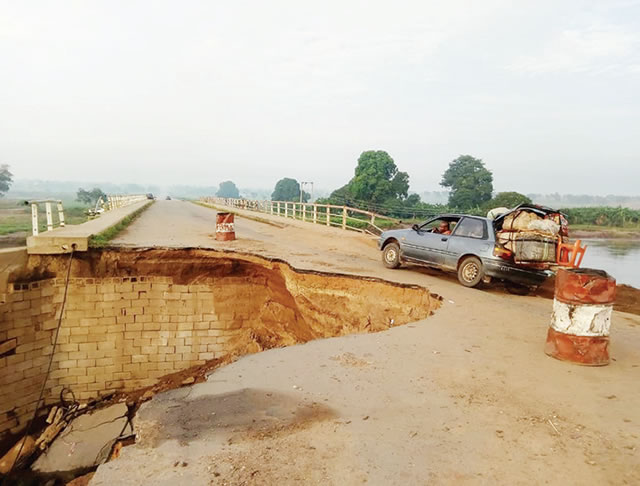
Heavy downpour triggers fresh collapse of strategic Taraba Bridge, strands hundreds
Hundreds of rural communities have been cut off from the rest of Taraba State following the collapse of a vital bridge linking the state capital, Jalingo, with Yorro and Zing Local Government Areas, as well as neighbouring parts of Adamawa State.
The incident occurred on Friday following more than five hours of torrential rainfall in the area.
This marks the second time the structure has failed in just two years, leaving scores of commuters, traders, and residents stranded on both sides of the crossing located at Mallam Audu village.
A critical economic lifeline cut off
The affected infrastructure, known as the Gadan-Mallam-Audu Bridge, is a critical economic artery. It serves as a major transport route for farmers, livestock dealers, traders, students, and civil servants traveling between Jalingo, Yorro, Zing, and Adamawa State.
Speaking on the development, a resident of Mallam Audu village, Hudu Adamu, lamented the severe economic impact the collapse would have on the region.
“This bridge is our major route for transporting farm produce and livestock to Jalingo and other parts of the country,” Adamu said.
Neglected warnings
According to residents, the disaster was entirely preventable. Adamu revealed that visible cracks had appeared on the structure months ago. Despite formal reports being lodged with both the Yorro Local Government Council and the Taraba State Government, no remedial action was taken.
The bridge was originally constructed through an intervention project by Hon. Kasimu Bello Maigari, the former member representing the Jalingo/Yorro/Zing Federal Constituency in the House of Representatives.
With economic activities now paralyzed and communities isolated, local leaders are crying out for immediate government intervention.
Bulus James, a community leader in the area, made an urgent appeal to both the Taraba State Government and the Federal Government to fast-track the reconstruction of the bridge. He emphasized that immediate action is crucial to restoring the movement of goods, services, and people before the situation degenerates further.
