


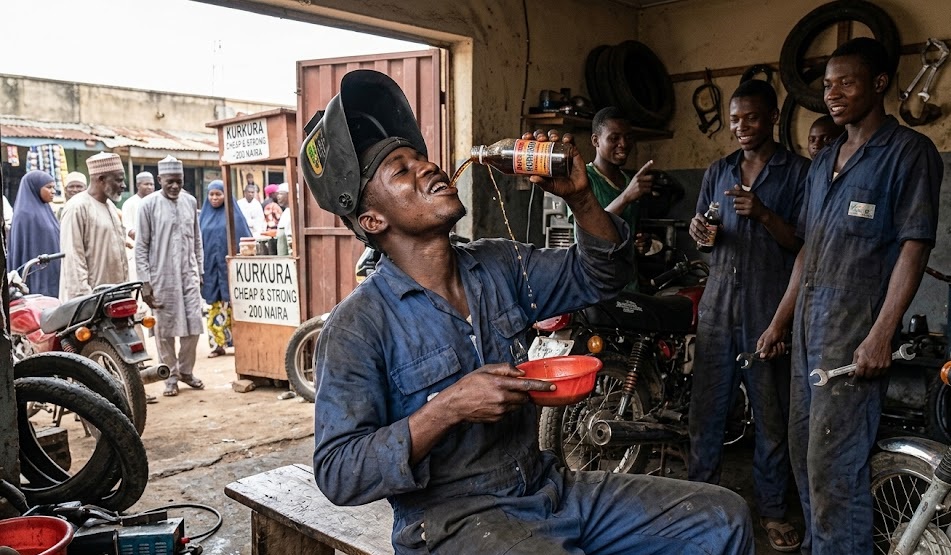
Inside the deadly boom of ‘A-Kurkura’, the toxic herbal wash hooking northern youth and married women
A popular herbal concoction marketed as a traditional cure-all has mutated into a dangerous, highly addictive narcotic sweeping across Northern Nigeria.
While users claim it boosts energy and sexual potency, medical experts and the National Drug Law Enforcement Agency (NDLEA) warn that the mixture is frequently laced with illicit drugs, leading to organ failure, psychosis, and sudden collapse.
It arrives in unassuming 100ml bottles, a brownish, bitter, and highly acidic solution sold for as low as ₦200 in motor parks and petty shops. It is called A-Kurkura (or simply Kurkura). Unlike conventional medications, it is never swallowed. Instead, users swirl it around their mouths for two to three minutes before spitting it out.
READ ALSO: NDLEA claims 50% of Nigerian students do drugs
What follows is an almost instantaneous bodily reaction. For some, it brings immediate dizziness, nausea, and vomiting. For others, it delivers a massive wave of stamina and intoxication that has turned thousands across Kaduna, Bauchi, and Sokoto states into severe addicts.
The name itself is benign. According to Dr. Abba Sagir, a lecturer in the Department of Nigerian Languages at Nasarawa State University, Keffi, the term is derived from the Hausa word kurkurawa, which means to rinse or gargle—most commonly associated with the Islamic ritual of ablution or post-meal cleaning.
But behind this traditional facade lies a harrowing public health crisis.
‘I feel on top of the world’: Why they are hooked
While some initially turn to A-Kurkura believing it cures haemorrhoids, rheumatism, fatigue, and common colds, many now use it strictly as a cheap substitute for banned narcotics.
Musa Kanin Mai Dawa, a 36-year-old welder in Zaria, openly admits to being a slave to the substance, using it up to seven times a day.
“I am already addicted to it, and can’t stop,” Musa said in a chat with Daily Trust . “Every time I rinse my mouth with it, I feel on top of the world. It makes me feel strong and energetic enough to do my job. Most youths in workshops use it now just for fun and energy.”
The addiction spans all demographics. In Zaria’s Unguwar Dan Magaji neighbourhood, Amina Sanda, a widow and mother of four, uses the rinse to survive the grueling physical demands of her daily business. Meanwhile, Adamu Garken Haka, a father of 24 children, admits he is hooked on the liquid solely for its properties as an aphrodisiac.
The booming demand has created a highly lucrative black market. One anonymous dealer in Zaria claimed he sells over 500 bottles a day, catering to a desperate clientele of young men, the elderly, and increasingly, married women.
Religious leaders raise the alarm over addicted homemakers
The surge of A-Kurkura usage among married women has sent shockwaves through religious communities in the North, prompting rare, urgent interventions from the pulpit.
Alkali Dikko Isiyaka Ibrahim, the Imam of the popular Leprosy Juma’at Mosque in Zaria, recently dedicated an entire Friday sermon to the crisis of drug abuse among housewives after witnessing the trend firsthand.
“My experience as a teacher in the married women’s section of an Islamic school gave me insight into the extent of drug abuse among women in our community,” Imam Dikko said, urging husbands to closely monitor their households. “Islam forbids any substance that can induce intoxication, even if it is socially accepted.”
Pastor Dan Ayuba, a senior administrator at the Catholic Church in Wusasa, Zaria, echoed this stance:
“Religion doesn’t allow the use of any substance that causes intoxication, even if it’s to be used for curing sickness.”
From Bauchi to Sokoto: Near-fatal collapses and rising prices
The crisis is spreading rapidly. In Bauchi, the substance is consumed openly in recreational areas. Its extreme potency was tragically demonstrated when Rabi Muhammad, a local resident, left a bottle brought by her brother at home. Her young child stumbled upon it and took a small sip.
“The child immediately collapsed and lost consciousness,” Rabi recounted. “It took great effort before he was revived.”
In Sokoto State, the trend has heavily permeated the elderly population, who use it under the guise of treating haemorrhoids. The high demand and recent law enforcement clampdowns have driven prices up significantly.
“It has become expensive. A bottle now sells for ₦1,000, unlike before when it was easily available,” an elderly user confessed. Despite knowing the risks, he stated, “As long as I can get it, I will continue using it.”
Conversely, those who survive a “bad trip” vow never to touch it again. One former user described the terrifying moment he tried A-Kurkura for a physical ailment:
“Suddenly, the ground seemed to spin beneath me… I felt a strange sensation from my toes up to my brain, and I lay flat like a corpse. I had to be carried home on a motorcycle. Never again.”
The medical reality: A sublingual gateway to brain damage
Why does a mouthwash trigger such an immediate, violent high?
Dr. Mairo Mandara, a prominent public health specialist, explained that while the original iteration of A-Kurkura was a crude herbal analgesic for toothaches, modern batches are actively laced with lethal psychotropic substances like marijuana, opium, or heroin.
“The drug causes an immediate reaction because it easily penetrates through the rich network of blood vessels under the tongue and quickly enters the circulatory system, reaching the brain directly,” Dr. Mandara explained.
She warned that the long-term consequences are catastrophic, leading to mental disorders, gout, and the potential loss of reproductive organs or fertility. “If left unchecked, there is a fear the North may lose its future,” she lamented.
Other medical professionals are equally blunt:
Dr. Ayuba Abdulrazaq (Pharmacist, ABUTH Shika): Classifies A-Kurkura as a dangerous, illegal substance. “Excessive use is highly toxic to the liver and kidneys, and can lead to irreversible kidney failure and severe mental health crises.”
Bala Gadanga (Sokoto State Health Officer): “A-Kurkura is poisonous. Manufacturers are mixing assorted narcotic plants such as tobacco and marijuana leaves. It triggers ulcers, brain damage, and liver failure.”
Dr. Bala Shehu (Bauchi Specialist Hospital): Notes that the substance strips users of inhibitions, driving them toward crime, anxiety, and depression. He advises youth to seek natural endorphins through exercise, football, and gym workouts rather than chemical highs.
NDLEA launches crackdown: Classified as an illicit ‘new psychoactive substance’
Recognizing the severe threat, the National Drug Law Enforcement Agency (NDLEA) has officially classified laced A-Kurkura as a New Psychoactive Substance (NPS) and banned its distribution.
Nuhu Ahmed, the NDLEA Zaria Area Commander, stated that the agency routinely raids suspected spots and sends seized bottles to research centers. “If we find cannabis, tramadol, or any other drug prohibited by law, anyone caught mixing it will be prosecuted,” Ahmed warned.
An intelligence officer with the Bauchi NDLEA command added that the substance has begun filtering into Southwestern Nigeria as well, warning that for those unaccustomed to its potency, accidental consumption can cause sudden death, requiring urgent intravenous fluids and blood transfusions to reverse.
The source trail: Produced in the South, Consumed in the North
Speaking extensively on the supply chain, NDLEA National Spokesperson Femi Babafemi revealed that rigorous investigations tracking the substance since its emergence in 2023 point to a specific geographic pipeline.
[Production Hubs: Ibadan (Oyo) & Kwara State]
│
▼
(Transit & Trafficking)
│
▼
[Consumption Hotspots: Kano, Jigawa, Kaduna & Bauchi]
According to Babafemi, while producers hide behind the alibi of “traditional medicine,” laboratory tests have repeatedly proven that the mixtures are heavily adulterated with illicit drugs like cannabis and opium.
“Products that do not contain harmful substances are not illegal,” Babafemi clarified to NigerianSketch.com. “However, those adulterated with illicit drugs violate the law. The agency is responding aggressively by arresting distributors, prosecuting offenders, shutting down illegal production sites, and destroying manufacturing equipment across the country.”
