


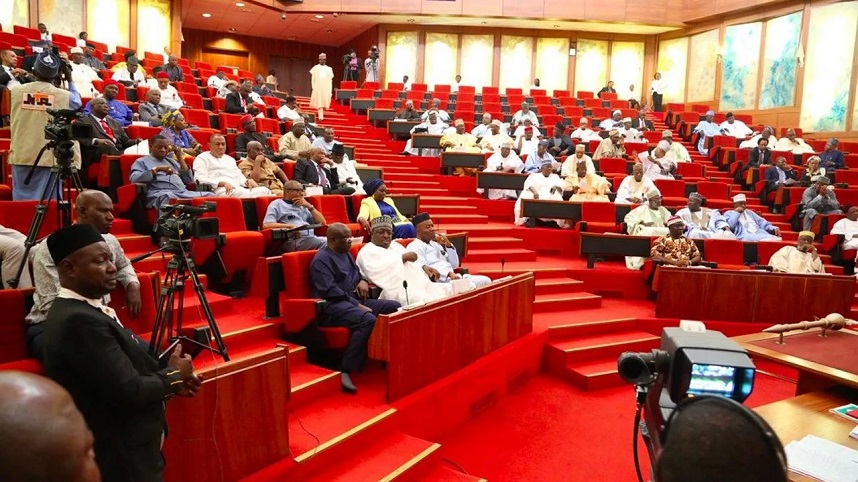
State police closer to reality in Nigeria as constitutional amendment passes House, scales Senate
Nigeria’s long-standing push for decentralised policing took a monumental leap forward on Thursday, June 11, 2026, as a bill seeking to establish state police cleared major legislative hurdles in both chambers of the National Assembly.
At the lower chamber, the House of Representatives passed the constitutional amendment bill during a consideration at the Committee of the Whole. Simultaneously, the upper chamber accelerated the reform process, with the bill successfully scaling its second reading in the Senate.
The piece of legislation is officially titled: “A Bill for an Act to Alter the Constitution of the Federal Republic of Nigeria, 1999 to Provide for the Establishment of State Police and for Related Matters (Sixth Alteration) Bill, 2026.”
The bill’s passage followed the presentation of a report by the Deputy Speaker and Chairman of the House Committee on Constitution Review, Benjamin Kalu.
READ ALSO: PATERNITY SHOCK: How I discovered two of my kids aren’t mine — Veteran actor, Taofeek Salami
In a decisive manual voting process, an overwhelming majority of 289 lawmakers voted in favour of the bill. The proposed legislation seeks to create a dual policing framework consisting of the Federal Police and autonomous State Police formations to combat the country’s spiralling security challenges.
Over at the Senate, the bill successfully scaled its second reading. Senate President Godswill Akpabio promptly referred the bill to the Senate Ad-hoc Committee on the Review of the 1999 Constitution for further legislative action.
Leading the debate on its general principles, Senate Leader Opeyemi Bamidele argued that Nigeria’s current centralised security system is severely overstretched. He noted that a locally grounded police force is best suited to battle prevailing threats, including terrorism and violent extremism, banditry and mass abductions, farmer-herder clashes, armed robbery, cultism, and cybercrime.
“Policing is most effective when it is locally grounded. Officers familiar with local languages, terrain, and social structures are better positioned to gather intelligence and respond to threats,” Bamidele stated, citing successful sub-national policing models in the United States, Canada, Australia, and Germany.
Inside the proposed framework: Rules, controls, and safeguards
To address deep-seated fears of political victimization and jurisdictional clashes, the bill outlines clear boundaries, appointment structures, and operational safeguards.
Structure and command
At the federal level, the Inspector-General of Police (IGP) will be appointed by the president on the advice of the Nigeria Police Council from among serving members of the federal police, subject to Senate confirmation.
At the state level, a state commissioner of police will be appointed by the state governor on the advice of the Nigeria Police Council from among serving officers of the state police, subject to confirmation by the respective State House of Assembly.
In the instance of a conflict, governors hold the power to issue lawful directives to state commissioners regarding public safety. However, if a commissioner deems an order unlawful or against policing standards, the matter will be referred to the Nigeria Police Council for a final, binding decision.
Oversight and oversight mechanisms
Section 214 of the constitution will be amended to formally establish both tiers. The National Assembly will retain the power to set the minimum operational and administrative standards for state police services.
The bill seeks to amend Section 84 of the Constitution to replace references to the National Police Council and the Federal Police Service Commission with the Nigeria Police Council and the Police Service Commission.
Federal intervention restrictions
The federal police cannot meddle arbitrarily in state security. Under the bill, federal intervention is strictly restricted to cases where there is a total breakdown of law and order. A state governor may formally requests intervention.
Despite yesterday’s historic milestone, the state police system is not an immediate reality. Because it requires an alteration of the 1999 Constitution, the bill must navigate a rigid, multi-stage ratification process.
Step 1: The House of Representatives passes the bill.
Step 2: The Senate agrees and passes it as well.
Step 3: At least 24 State Assemblies (two-thirds of them) approve it.
Step 4: The President signs and approves the bill.
Step 5: Individual states officially turn it into law.
Even after receiving presidential assent, no state police formation can commence operations until the respective State House of Assembly passes an enabling local law, and the formation is certified to have met the national standards prescribed by the National Assembly. The Federal Police will maintain total jurisdiction in any state until its local counterpart is fully certified and operational.
Experts warn over funding and replication of failures
While political analyst Professor Saleh Dauda acknowledged that overwhelming insecurity makes decentralised policing an inevitable necessity, other security experts have urged caution.
In a chat with Daily Trust, security expert Patrick Agbambu questioned the financial readiness of Nigerian states to fund a modern police force.
“Which state in Nigeria can effectively fund a police force as we speak? Even in the United States, many states struggle with police funding,” Agbambu warned. He also expressed doubts about whether state police forces could effectively confront heavily armed terrorists and bandits given existing national deficiencies in equipment.
Similarly, security analyst Kabiru Adamu warned that without deep structural reforms, Nigeria might just be decentralising its problems.
“This is only the first logical step,” Adamu noted. “If what will happen is the recreation of the federal police at the 36 states, then instead of dealing with one policing problem, Nigeria may end up dealing with 37 policing problems.”
Adamu highlighted that Nigeria currently has fewer than 400,000 police officers nationwide—a significant manpower deficit noted also by Senator Adamu Aliero during the Senate plenary.
The evolution of the state police debate
The journey toward state policing has been a long, shifting policy tug-of-war across multiple administrations. Below is a timeline showing how Nigeria’s leadership has reacted to the issue up to this critical legislative juncture:
January 5, 2022: Former President Muhammadu Buhari explicitly rules out state police as an option for tackling insecurity.
April 22, 2024: Former President Goodluck Jonathan reverses his previous posture, describing state police as the “only solution” to the nation’s security crises.
June 16, 2025: Former IGP Kayode Egbetokun strongly opposes the policy, arguing instead for the strengthening of the centralized Nigeria Police Force. (Egbetokun was subsequently sacked by President Tinubu on February 23, 2026).
February 25, 2026: President Bola Ahmed Tinubu formally appeals to the 10th National Assembly to amend the constitution to provide a legal framework for state police.
March 4–26, 2026: Newly appointed IGP Tunji Disu takes a proactive approach, setting up an eight-member committee that swiftly submits a decentralised policing framework to Deputy Senate President Barau Jibrin.
June 11, 2026: The House of Representatives passes the bill as it clears its second reading in the Senate, marking the closest Nigeria has ever come to returning to the decentralised regional policing models of the First Republic.
