


State police wins big as Senate passes crucial alteration bill
The long-debated decentralization of policing in Nigeria gained massive momentum following the Senate’s passage of the constitutional amendment bill to establish state police.
The piece of legislation, titled “A Bill for an Act to Alter the Constitution of the Federal Republic of Nigeria, 1999 to Provide for the Establishment of State Police and for Related Matters (Sixth Alteration) Bill, 2026,” moved closer to reality after receiving a fast-tracked hearing following an executive request from President Bola Ahmed Tinubu.
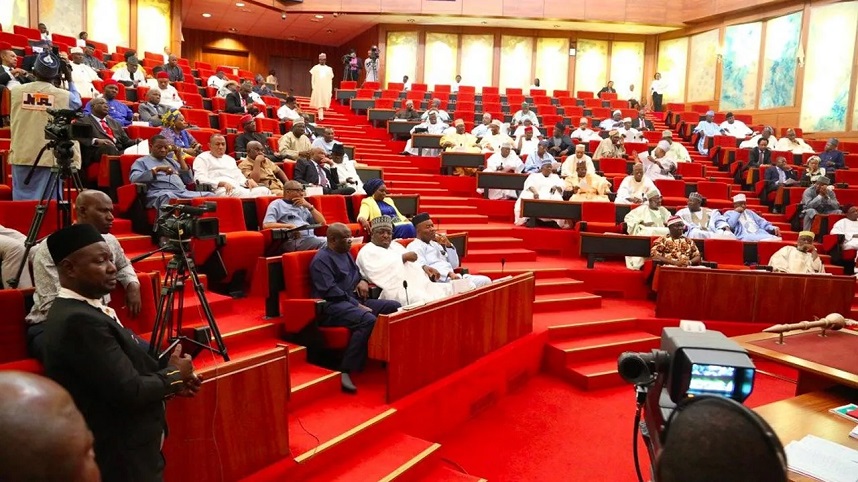
The bill’s passage followed a whirlwind session in the Red Chamber. Leader of the Senate, Opeyemi Bamidele (APC, Ekiti Central), presented the bill for its first, second, and third readings in one sitting after President Tinubu lettered the Senate requesting speedy consideration.
However, the session was not without drama.
The chamber plunged into a rowdy session when Senate President Godswill Akpabio announced the presence of high-profile visitors, including Chief of Staff Femi Gbajabiamila and the governors of Ogun, Ondo, and Kaduna states. Senators initially rejected a motion to suspend regular rules to admit them, but Akpabio ultimately overruled the dissenters after a voice vote.
READ ALSO: ‘NIGERIANS CAN’T EAT ROADS’: ADC blasts presidency over Onanuga’s ‘no hunger’ claims
Lawmakers spent nearly 30 minutes preparing for electronic voting, only to discover that several electronic voting machines were non-functional. The Senate was forced to revert to manual voting, where a majority voted in support of altering all 26 clauses slated for amendment.
According to the Senate Leader, the bill effectively replaces the uniform structure of the Nigeria Police Force.
The bill retains the Federal Police Service (FPS) for national security responsibilities while creating a framework for State Police Services (SPS) for subnationals that choose to establish them through their respective State Houses of Assembly.
Strict operations criteria
No state police formation can hit the ground running unless it is duly established by state law and formally certified as meeting the national minimum standards prescribed by the National Assembly. The federal police will continue to manage security in any state until its local counterpart is fully certified and operational.
At the federal level, the president appoints the Inspector-General of Police on the advice of the Nigeria Police Council (NPC), subject to Senate confirmation.
Governors will appoint State Commissioners of Police on the advice of the NPC, subject to confirmation by the respective State House of Assembly.
Governors can issue lawful directives to State Commissioners regarding public safety. However, if a commissioner deems an order unlawful or against professional standards, the matter can be referred to the NPC for a final decision.
Addressing widespread public anxiety over the potential weaponization of local police forces by governors, Senator Bamidele stated that the bill introduces strict constitutional safeguards.
The bill explicitly prohibits governors from directing state police to unlawfully target specific individuals, political parties, ethnic or religious groups.
The National Assembly retains the power to dictate uniform national minimum standards regarding recruitment, training, firearms usage, discipline, and data management.
When can the federal police intervene?
The Federal Police Service reserves the right to step into a state under strict circumstances authorized in writing by the President. These include an outright breakdown of public order, an operational or financial collapse of the state’s police service, serious violations of fundamental human rights, documented records of electoral intimidation, serious threats to national security.
Despite the Senate’s approval, the legislative journey is far from over.
Once the National Assembly harmonizes the executive and legislative versions, the final draft must be approved by a two-thirds majority of the 36 State Houses of Assembly (at least 24 states) before it returns to the President for assent. Individual states must then pass local enabling laws before creating their commands.
Mixed Reactions: Experts and stakeholders weigh in
The legislative milestone has split opinion among security experts and political analysts.
Supporters, including the chairman of the Senate Committee on Power, Senator Enyinnaya Abaribe, former Sokoto State Governor Aminu Tambuwal, and Senate Chief Whip Tahir Monguno, threw their weight behind the amendment, citing prevailing security challenges as a justification for local policing.
“Conventional security institutions alone cannot provide all the security needs of the country without active public participation. The common position is that state police is good and will be beneficial… The only thing now is to give it a try.”
— Muhammed Usaini Gumel, Retired Deputy Inspector-General of Police
Conversely, political analyst and columnist Hassan Hussain cautioned against what he described as a rushed “legislative emergency,” urging lawmakers to consider historical contexts and economic realities.
Hussain recalled Nigeria’s First Republic experience (1962–1965), where regional police forces were weaponized as tools for political intimidation, prompting the military regime to centralize the police force.
Hussain estimated that establishing state police nationwide could cost between ₦589 billion and ₦813 billion over five years. Given that many states currently struggle to pay salaries, he warned that poorly funded local police forces could lead to armed corruption.
Hussain also cautioned that without strict guardrails, emerging technologies like AI-driven surveillance and facial recognition could be weaponized at the subnational level to deepen communal and political divides.
