


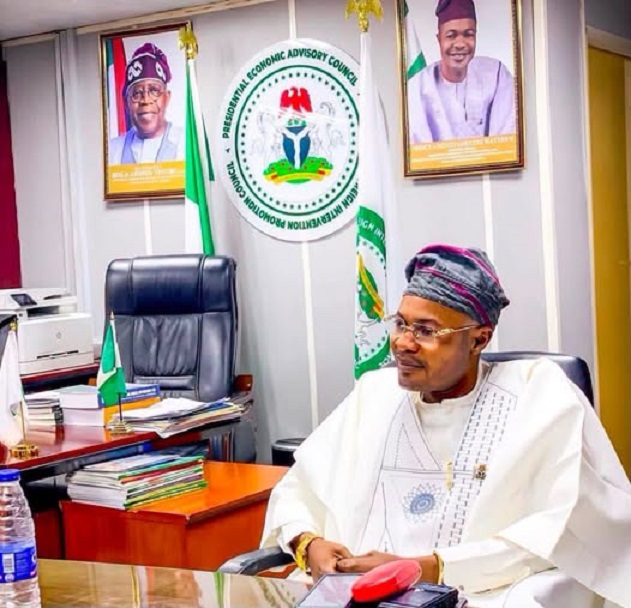
N1.3bn Budget Mystery: Questions linger as presidency clears Gbajabiamila of ‘phantom’ Council fraud
The Presidency in Nigeria has absolved Femi Gbajabiamila, the Chief of Staff to President Bola Ahmed Tinubu, of any involvement in a controversial, non-existent agency dubbed the “Presidential Foreign Intervention Promotion Council” (also referred to as the Presidential Economic Advisory Council).
In a statement, the federal government labeled the acclaimed Director General of the disputed body, Prince Adeniyi Adeyemi, a “con artist” who forged his way into official circles, vowing that he will soon face justice in court.
However, the presidency’s defense remained conspicuously silent on critical elements of the brewing scandal. It failed to address how the “phantom” council was successfully smuggled into the 2026 budget with a N1.3 billion allocation, nor did it touch upon Adeyemi’s explosive claims that he paid a N400 million proxy bribe to Gbajabiamila, with an alleged demand from the Chief of Staff for a 48 percent cut of the council’s N27 billion take-off grant.
The counter-accusations and demands for probe
The controversy reached a boiling point after Gbajabiamila issued an initial disclaimer denying the council’s existence. Adeyemi fired back during a press conference, blasting the disclaimer as “a cloud of public misrepresentation, institutional denial, and a deliberate attempt to silence legitimate questions.”
Adeyemi challenged President Tinubu to institute an independent investigative panel to compel the Chief of Staff to step aside during investigations; submit all official documents signed by Gbajabiamila since taking office to forensic analysis; review budgetary references and institutional records; as well as investigate alleged assassination attempts on Adeyemi’s life.
READ ALSO: Controversy over Tinubu’s ‘phantom’ presidential council as DG accuses Gbajabiamila of ₦400m bribe
Despite the council’s website (www.pfipc.gov.ng) being entirely inactive, checks revealed that Adeyemi had successfully leveraged its Instagram presence—headlined with the mandate of “Facilitating global partnerships & foreign investment into Nigeria”—to hold high-level official engagements with strategic statutory bodies.
Before the bubble burst, Adeyemi had met with leadership at the Economic and Financial Crimes Commission (EFCC), the Nigerian Electricity Regulatory Commission (NERC), the Raw Materials Research and Development Council (RMRDC), and the China Investment Business Development Commission (CIBDC).
‘He’s an Impostor’: Presidency lays out the facts
Breaking its silence on Wednesday, the presidency, through a statement by the Special Adviser to the President on Information and Strategy, Bayo Onanuga, detailed how Gbajabiamila actually blew the whistle on the fraud as far back as October 17, 2025.
According to Onanuga, the Office of the Chief of Staff petitioned the DSS and the Police after the Nigerian Investment Promotion Council (NIPC) complained that a parallel agency was operating at cross-purposes with it.
The statement noted that Adeyemi’s sophisticated operation began crashing after he held an unauthorized meeting with foreign ambassadors at the Wells Carlton Hotel in Asokoro, prompting the Ministry of Foreign Affairs to demand clarifications.
“The Chief of Staff could not have issued a letter of appointment to a non-existent agency. Moreover, the Chief of Staff does not make appointments or write letters, as these are the exclusive preserve of the Office of the Secretary to the Government of the Federation,” Onanuga stated.
According to police investigation reports cited by the presidency, Adeyemi operated 34 distinct bank accounts, nine of which were opened under fictitious agency names like the FCT Investment Promotion Agency. He successfully misled the Office of the Accountant-General of the Federation to open a Central Bank of Nigeria (CBN) account, though no government funds were moved into it. He forged documents to solicit a note verbale from the Ministry of Foreign Affairs to secure US visas for himself and his “staff.”
Onanuga revealed that an eight-count charge of criminal forgery, impersonation, and obtaining by false pretense was filed against Adeyemi and two accomplices at the Federal High Court in Abuja on November 27, 2025. Adeyemi, who was on police bail when he launched his recent media campaign against Gbajabiamila, is scheduled to appear in court on July 27.
The presidency also pointed out that Adeyemi had a history of elaborate scams, recalling a 2016 incident where he falsely paraded himself as the President-General of a fake United Nations-affiliated “World Youth Organisation” until the UN debunked the claim.
Civil society demands independent probe, warns against silence on N1.3bn budget inclusion
Reacting to the development, prominent Civil Society Organisations (CSOs) have warned that simply discrediting Adeyemi does not automatically clear the air regarding the serious corruption allegations raised against the presidency’s top scribe.
Speaking on the matter, the executive director of the Civil Society Legislative Advocacy Centre (CISLAC) and Head of Transparency International Nigeria, Comrade Auwal Musa Rafsanjani, pressed for an impartial, independent investigation.
“While allegations alone do not amount to guilt, they should not be dismissed or ignored,” Rafsanjani said. “Public confidence in government institutions depends on the willingness of authorities to subject all public officials to the same standards of accountability. We must avoid selective enforcement of our laws because this weakens public confidence.”
Similarly, Okechukwu Nwanguma, Executive Director of the Rule of Law and Accountability Advocacy Centre (RULAAC), noted that the Presidency’s heavy reliance on discrediting the accuser fails to comprehensively address the specific bribery allegations and the bizarre inclusion of the phantom council in the national budget.
“The credibility of an accuser and the veracity of specific allegations are related but distinct issues,” Nwanguma argued. “Simply discrediting the accuser, even if he is eventually proven to be an impostor, does not automatically dispose of every allegation he has made. If the allegations against the Chief of Staff are false, an independent investigation will clear his name.”
Both bodies urged all parties to let the criminal trial against Adeyemi run its course without political interference, emphasizing that transparent due process, rather than competing media narratives, remains the only way to sustain public trust in Nigeria’s anti-corruption war.
