


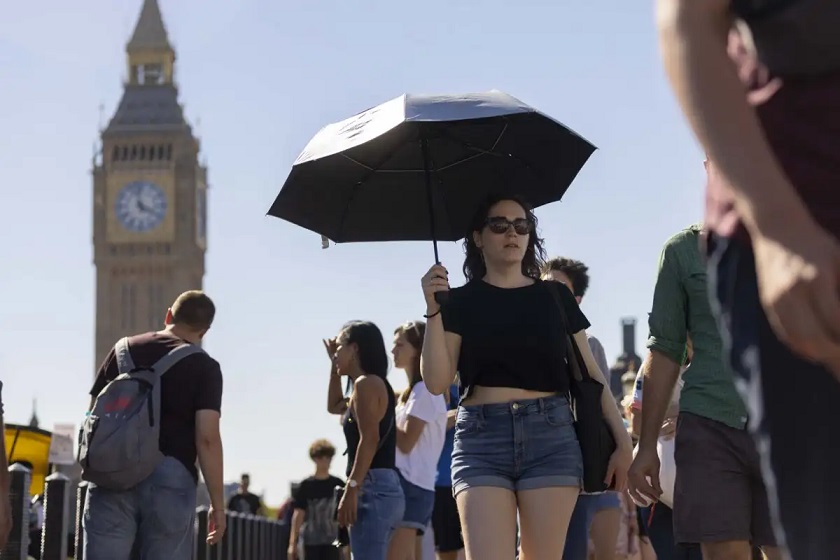
UK HEATWAVE: Climate change linked to 2,700 deaths in England, Wales
An estimated 2,700 people are believed to have died in England and Wales following severe heatwaves that struck the United Kingdom (UK) between May and June, a new joint study released on Monday has revealed.
The research, conducted by experts from Imperial College London, the UK Met Office, and the London School of Hygiene and Tropical Medicine, highlights the growing and fatal dangers of global extreme weather.
According to the report, human-induced climate change played a massive role in the fatalities, accounting for nearly half of the recorded deaths.
“More than 2,700 people are thought to have died from heat-related causes during the May and June heatwaves in England and Wales,” the UK Met Office said in an official statement. “Of those, it’s estimated that 42% died as a result of the extra heat caused by human-induced warming.”
READ ALSO: England fans worry about Kylian Mbappe’s speed against Kyle Walker in defense
The study focused specifically on England and Wales, noting that Scotland and Northern Ireland did not experience the same extreme temperature spikes.
The early-season heatwaves shattered long-standing historical records. In May, West London recorded a national record of 35.1°C. This was followed by three consecutive days of record-breaking June temperatures, culminating in heat exceeding 37°C in East Anglia.
Experts pointed out that these temperatures are extreme even for the height of mid-summer, as July and August typically bring the UK’s peak heat.
The report further disclosed that daytime maximum temperatures across England and Wales are now roughly 3°C to 4°C hotter than they would have been without human-driven climate change.
While Southern England experienced the highest overall temperatures, data revealed that the death rate per million people was surprisingly similar in the Midlands—a region further north.
READ ALSO: 2026 World Cup a ‘fixed’ tournament: Egypt, pundits lament VAR decisions in Argentina win
“With this region less frequently exposed to extreme heat, it suggests residents there are more vulnerable to the impacts,” the researchers noted.
Breaking down the fatalities, the study showed that approximately 59% of the deaths in May and 38% in June were directly attributable to the additional heat generated by global warming.
Reacting to the findings, Clair Barnes, a research associate in extreme weather and climate change at Imperial College London, warned that countries must urgently adapt to a shifting climate reality.
“It’s time we woke up to the fact that we now live in a country with dangerously hot summers,” Barnes said. “To protect people during future extremes, we must urgently adapt to the reality of the climate we now have, and double down on global efforts to reach net zero emissions to stop this from getting worse.”
Mark McCarthy, the Manager of Climate Attribution at the Met Office, described the weather patterns of 2026 as “exceptional.” He noted that the early-season heatwaves successfully smashed previous temperature records that had stood firmly since May 1944 and June 1976.
