


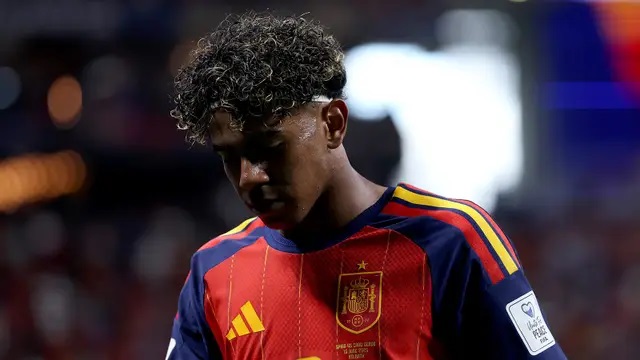
WORLD CUP 2026: Debutants Cape Verde cause major upset, hold European champions Spain to goalless draw
Spain’s quest for a second FIFA World Cup title suffered an unexpected and bruising setback on Monday, as the reigning European champions were held to a shocking 0-0 draw by tournament debutants Cape Verde in their Group stage opener in Atlanta.
Despite dominating possession and carving out the lion’s share of scoring opportunities, La Roja simply could not break down a fiercely disciplined Blue Sharks side. The African newcomers ultimately produced what is already being hailed as one of the biggest giant-killing acts of the tournament so far.
The disappointing result leaves Spain with a mountain of work to do in their remaining group fixtures, while simultaneously resurrecting familiar ghosts regarding their ability to convert overwhelming midfield dominance into clinical goals on football’s grandest stage.
Making their first-ever appearance at a FIFA World Cup, Cape Verde delivered a masterclass in defensive resilience—a performance destined to be etched in the annals of the island nation’s sporting history.
Ranked 67th in the FIFA world rankings and representing a population of just over half a million people, Cape Verde displayed remarkable tactical organization, rigid discipline, and a relentless work ethic to completely frustrate one of the tournament heavyweights.
For long stretches of the encounter, the Blue Sharks remained incredibly compact at the back. They choked out Spain’s creative passing lanes, isolated their forwards, and forced the European giants into speculative, long-range efforts. The final whistle sparked wild celebrations among Cape Verde’s players and traveling fans, who rightly celebrated the historic point as an outright victory.
Yamal starts on the bench
Much of the pre-match chatter centered around Spain’s 18-year-old wunderkind, Lamine Yamal, who was surprisingly omitted from the starting lineup.
The Barcelona starlet only recently returned to action following a grueling hamstring injury that kept him on the sidelines for nearly two months. This forced Spain’s head coach, Luis de la Fuente, to cautiously manage his minutes. Furthermore, another explosive winger, Nico Williams—also easing his way back from an injury-disrupted club season—was held back until the game’s dying embers.
In their absence, Spain’s frontline looked devoid of urgency, pace, and imagination. The toothless display subtly exposed just how heavily this transitionary Spanish team relies on its youthful stars to inject fear into opposition defenses.
While Spain enjoyed comfortable, low-tempo possession throughout the first 45 minutes, they struggled to breach Cape Verde’s low block.
Spain’s best opening of the first half came six minutes before the interval when Marc Cucurella delivered a dangerous, looping cross, only for Ferran Torres’ venomous strike to rattle off the crossbar.
When the outfield defense cracked, Cape Verde’s veteran goalkeeper, Vozinha, stood like a colossus. He pulled off a string of world-class saves, denying Mikel Oyarzabal from close range and subsequently thwarting goalbound efforts from Torres and center-back Aymeric Laporte to keep the scoreline level at the break.
Recognizing the desperate need for attacking impetus, De la Fuente finally threw Yamal into the fray midway through the second half.
The teenager instantly electrified the stadium, injecting immediate pace and directness into a stagnant Spanish attack. With virtually his first touch, Yamal set up substitute Mikel Merino for a half-chance. Moments later, he orchestrated Spain’s finest passing move of the half, which culminated in an Oyarzabal shot being deflected just over the bar.
Yet, even Yamal’s sublime creativity failed to pick the lock of a stubborn, heroic Cape Verde backline.
As Spain pushed men forward in a desperate search for a stoppage-time winner, it was actually Cape Verde who came agonizingly close to scripting an even bigger fairytale.
In the final minute of normal time, Diney Borges rose highest to meet a swinging cross inside the box. However, his powerful header was directed too close to Spanish shot-stopper Unai Simón, who gathered comfortably. Had that gone either side of the keeper, it would have sealed one of the most seismic upsets in World Cup history.
Echoes of past World Cup failures
For Spanish fans, this stalemate carried a bitter sense of déjà vu. Since famously lifting the trophy in 2010, Spain has notoriously struggled to assert its dominance on the global stage.
2014: Shock group-stage exit as defending champions.
2018 & 2022: Frustrating knockout-stage exits on penalties, despite hoarding over 70% possession.
The inability to turn sterile possession into goals remains Spain’s Achilles’ heel. Ironically, however, Spain’s triumphant 2010 campaign in South Africa also began with an opening-match shocker—a 1-0 defeat to Switzerland—before they recovered to win the tournament. De la Fuente will be praying history repeats itself.
Spain must quickly dust themselves off as attention shifts to a must-win clash against Saudi Arabia in Atlanta this coming Sunday. Anything less than three points will put immense pressure on the European champions heading into their final group fixture.
Conversely, Cape Verde will carry sky-high confidence into Miami for their next assignment against South American powerhouse Uruguay, as the African side looks to extend their dream World Cup debut.
