


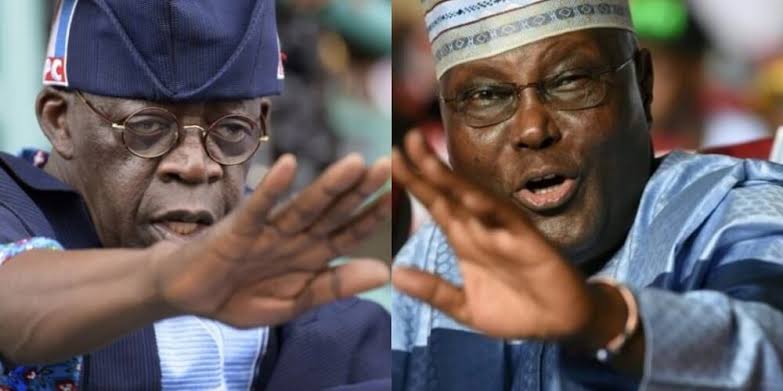
Atiku’s $1.2m US lobbyist submits Tinubu’s forfeiture records to Trump, Congress
A Washington-based lobbying firm representing former Nigeria vice president, Atiku Abubakar, has submitted federal court records and documents detailing President Bola Ahmed Tinubu’s 1990s US forfeiture case to the Donald Trump administration and key members of the US Congress.
The firm, Von Batten-Montague-York, L.C., disclosed that it began distributing over 60 pages of US Department of Justice (DOJ) court filings, affidavits, and recent judicial decisions to senior US officials, White House staff, and congressional committees.
Atiku, who ran as the presidential candidate for the African Democratic Congress (ADC), retained the Washington lobbying outfit in March under a 12-month, $1.2 million contract. The engagement is intended to boost his international standing, facilitate high-level diplomatic outreach in the US, and push back against official narratives from Abuja.
READ ALSO: ”WE CAN’T LECTURE INEC”: Ubani raises alarm as technical failures mar NBA presidential polls
In a post on its official X handle, the firm claimed that many key decision-makers in Washington were previously unaware of the historical DOJ filings linked to the Nigerian leader. It stated that the document drive was designed to bring the full context of the case directly to President Donald Trump’s attention.
”Following discussions with members of the @realDonaldTrump Administration, Congress, and senior congressional staff, we began providing more than 60 pages of @TheJusticeDept documents concerning the DOJ’s allegations of Nigerian President Bola Ahmed Tinubu’s (@officialABAT) alleged involvement in a heroin trafficking investigation spanning the late 1980s and early 1990s,” the firm stated.
The documents circulated by the lobbying firm are titled “Background and Chronology of the 1993 U.S. Department of Justice Heroin-Proceeds Forfeiture Case and the 2023 FOIA Litigation Concerning Alleged Heroin Trafficking from Nigeria to the United States Involving Bola Ahmed Tinubu, the current President of the Federal Republic of Nigeria.”
What the US files contain
According to the dossier shared by Von Batten’s firm, the US Department of Justice investigated a Nigerian-led drug syndicate between 1988 and 1991 for smuggling white heroin into Chicago. Federal investigators alleged that proceeds from the operation were funneled into US bank accounts owned and controlled by Tinubu.
The filings in United States v. Funds in Account No. 263226700 et al. named three key figures: Bola Ahmed Tinubu, Adegboyega Mueez Akande and Abiodun Agbele.
The DOJ alleged that Akande was the head of the trafficking network and provided funds to open at least one of Tinubu’s accounts. Agbele was described as an associate who sold heroin to an undercover officer before turning federal informant.
The case, filed in 1993 in the U.S. District Court for the Northern District of Illinois, sought the forfeiture of the funds, alleging they were drug proceeds or involved in money laundering. The matter was ultimately resolved through a negotiated civil forfeiture settlement, resulting in $460,000 being forfeited to the US government.
Ongoing legal battles and diplomatic fallout
The dossier compiled by the lobbyists also highlights recent legal battles surrounding the release of sealed records.
In 2023, American journalist Aaron Greenspan filed a Freedom of Information Act (FOIA) lawsuit seeking full disclosure from agencies including the FBI and the Drug Enforcement Administration (DEA). In 2025, a US District Court ruled that these agencies could not issue blanket refusals to process portions of the FOIA request, ordering them to process the files. That litigation remains active.
Von Batten’s firm noted that the documents were shared with key US House and Senate committees for “informational and oversight purposes,” particularly amid reports that President Tinubu is seeking a bilateral meeting with Trump during the upcoming UN General Assembly.
The Nigerian legal verdict
The 1993 Chicago court case was a focal point of opposition challenges following Nigeria’s 2023 presidential election. Both Atiku Abubakar (then of the PDP) and Labour Party candidate Peter Obi argued before the Presidential Election Petition Court (PEPC) that the $460,000 civil forfeiture rendered Tinubu ineligible to hold office.
However, the PEPC dismissed those arguments in its judgment, holding that there was no criminal conviction. The petitioners failed to establish that Tinubu was ever charged, tried, or convicted of a criminal offense in the United States.
The PEOC also concluded that the forfeiture was civil in nature (in rem), targeting the property rather than establishing criminal culpability.
The court found no evidence that Tinubu lied on his INEC declaration forms regarding criminal convictions.
While the legal matter remains settled in Nigeria, Atiku’s Washington representatives are clearly leveraging the court history to influence political sentiment within the US capital.
