


How Nigerian agencies without mandates got N30bn for palaces, worship centres
Questions and widespread criticism have trailed the allocation of N30.15 billion in the 2026 federal budget for the construction, renovation, and furnishing of traditional palaces and religious projects across Nigeria.
The disclosures, contained in a budget tracking report released on Wednesday by public accountability watchdog Tracka—an initiative of the BudgIT Foundation—come at a time when the country is grappling with a N31.45 trillion budget deficit, rising public debt, and underfunded critical sectors like health and education.
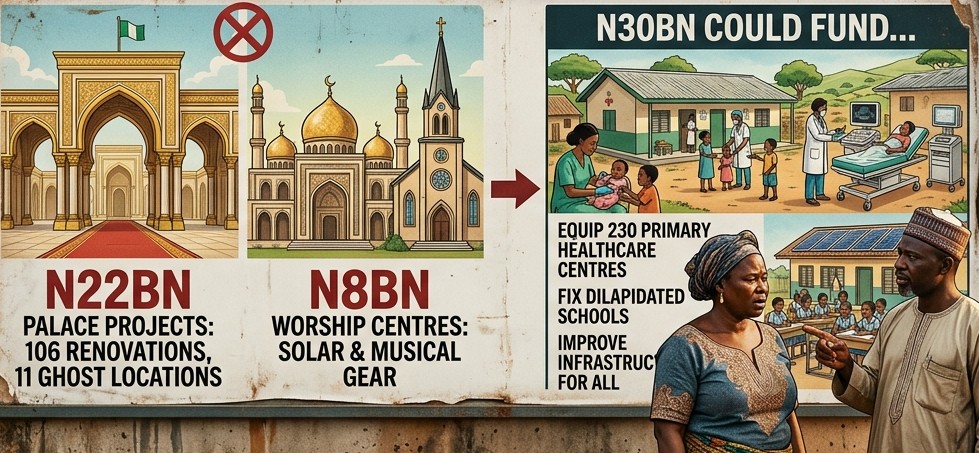
A breakdown of the numbers shows that N22.15 billion was earmarked for the renovation and furnishing of 106 palaces nationwide, while N8 billion was set aside for church and mosque projects.
READ ALSO: ”WE CAN’T LECTURE INEC”: Ubani raises alarm as technical failures mar NBA presidential polls
Tracka’s review exposed significant governance and oversight concerns within the budget allocations. Notably, 11 palace projects worth N5.85 billion have no identified physical locations, making public monitoring and tracking virtually impossible.
Furthermore, none of the 45 Ministries, Departments, and Agencies (MDAs) assigned to execute these multi-billion-naira palace projects possesses the legal or statutory mandate to construct or renovate royal structures. Instead, lawmakers routed allocations through research institutes, agricultural colleges, health facilities, and specialized agencies, effectively bypassing standard procurement scrutiny.
Some of the notable agency allocations include:
Federal Cooperative College, Ibadan: Assigned N2.661 billion for community halls and palaces in Lagos, alongside projects in Ekiti South (N350 million) and Ondo South (N210 million).
Sheda Science and Technology Complex (SHESTCO), Abuja: Allocated N1.54 billion to modernize and furnish selected national heritage palaces nationwide.
Nigerian Building and Road Research Institute (NBRRI), Lagos: Designated to handle N3.92 billion across multiple states, including N1 billion for solar power and pavilions at Oluyin Palace in Iyin Ekiti.
Agricultural Research Council of Nigeria: Slated to manage N750 million for palace projects in Kogi State.
National Cancer Research Institute (NICRAT): Earmarked N200 million under the Ministry of Health to renovate district heads’ palaces in Sokoto State.
Federal Neuro-Psychiatric Hospital, Dawanau: Listed among implementing bodies to execute N42 million in palace projects.
Breakdown of religious spending
Tracka noted that N1.91 billion was allocated to seven church-related projects, while N6.14 billion was earmarked for 52 mosque projects across the country.
The scope of work covers the rehabilitation of worship centres, installation of solar power systems, sinking of boreholes, purchase of musical equipment, procurement of carpets, construction of imam residences, and support for Islamiyya school facilities.
High-profile items include a N1 billion allocation for solar power installations at mosques in Zamfara State and a N1 billion project for church equipment in Abia State.
Deputy Speaker defends N1bn Abia allocation
Reacting to public outcry over the N1 billion allocation for churches in his Bende Federal Constituency of Abia State, Deputy Speaker of the House of Representatives, Benjamin Kalu, clarified that the project was not meant solely for musical instruments.
In a statement issued Wednesday by his Chief Press Secretary, Levinus Nwabughiogu, Kalu explained that the funds—which net roughly N780 million after statutory deductions like VAT—are tied to a broader youth reorientation, mentoring, and anti-social vice program.
“Nation-building must go beyond roads and physical infrastructure. Government must also invest in building the character and value system of the people who use the infrastructure using various value-delivery platforms,” Kalu stated.
Kalu added that a letter of corrigendum has been initiated to amend the budget description before implementation begins, noting that no funds have been disbursed as the 2026 budget is yet to be implemented.
What N8bn Could Fund in Healthcare
The N8.05 billion allocated for religious projects presents a stark contrast when evaluated against the needs of Nigeria’s primary healthcare system.
Based on current market estimates from Nigerian biomedical equipment suppliers, equipping a basic primary healthcare centre (PHC) with essential diagnostic, laboratory, and maternal tools costs between N35 million and N50 million.
The N8.05 billion earmarked for worship places could fully equip between 160 and 230 primary healthcare facilities nationwide.
