


Trump assesses U.S. economy via Wall Street, but millions of Americans remain left out
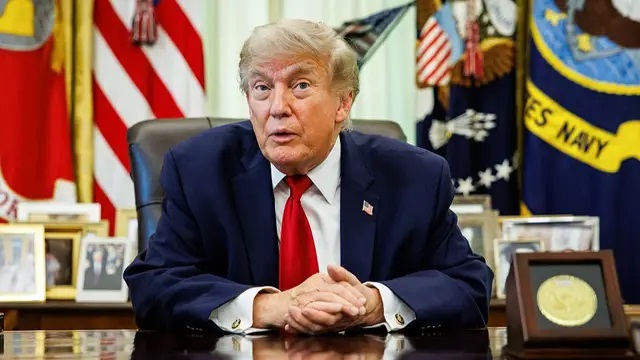
U.S. President Donald Trump kicked off the week with an unprecedented Oval Office first: ringing the opening bell of the stock market.
The symbolic moment highlights a defining feature of his second term. Trump has increasingly used Wall Street’s gains as the ultimate scoreboard for his presidency, pointing to record stock prices as absolute proof that his economic policies are working.
However, beneath the flashing green numbers on Wall Street lies a stark economic disconnect. Millions of everyday Americans remain severely squeezed by a high cost of living, and a massive portion of the population owns no stock at all.
Some economists warn that Trump’s heavy reliance on stock performance risks conflating the fortunes of financial markets with the actual day-to-day realities of American households. Currently, roughly four in ten Americans have zero money invested in the markets.
READ ALSO: 2026 WORLD CUP: FIFA, Collina fire back over Donald Trump’s ‘suspect’ referee claims
Despite this, President Trump has routinely pointed to rising equities to validate a wide array of controversial policies, including his geopolitical standoff with Iran, aggressive global tariffs andweeping domestic legislation.
Direct federal intervention in corporate balance sheets, such as taking an equity stake in Intel and securing “golden shares” and revenue-sharing agreements with tech giants like U.S. Steel, Nvidia, and AMD.
Trump frequently boasts about the market at rallies, global summits, and even solemn military events. In June, right before awarding the Medal of Honor to three servicemembers, Trump told the audience:
“The stock market just hit a new all-time high, the 401(k)s are at a new all-time high, and oil is dropping like a rock.”
The “Trump accounts” push
To bridge the gap and push more Americans into the trading game, the administration has introduced aggressive corporate-centric initiatives. The Republicans’ $4.1 trillion “One Big Beautiful Bill” created government-seeded investment accounts for newborns, dubbed “Trump accounts.” Additionally, plans were unveiled to match up to $1,000 in 401(k) contributions for workers enrolling in “Trump IRA” accounts.
White House spokesman Kush Desai defended the strategy, stating that Trump is “simultaneously focused on ensuring every American has a stake in the successes of America’s next golden age with their own piece of the pie.”
Despite the administration’s optimism, critics and data suggest the focus on corporate growth ignores a vast segment of the population, fueling what economists call a “K-shaped” economy.
While the U.S. stock market has surged by $15 trillion (a 25% increase) since Trump returned to office, Gallup polling reveals that about 40% of the country owns no stock. Furthermore, the wealthiest 1% own more than half of all U.S. capital market investments.
For the bottom half of households, wealth is tied up in illiquid assets like real estate and durable goods, meaning Wall Street rallies do little to help their immediate finances. While the broader U.S. economy maintains steady growth and low unemployment, recent inflation—exacerbated by tensions with Iran—has left many consumers feeling sour about their economic future.
An imperfect metric for success
Trump’s fixation on the market may also be deeply personal. According to recent financial disclosures, the president is heavily exposed to the market himself. In the first three months of 2026, his investment accounts executed 3,600 trades valued between $212 million and $695 million.
“You know why I’m profiting? Because the stock market’s going up, everybody’s profiting,” Trump declared recently.
Even his closest allies acknowledge the limitations of using Wall Street as an economic yardstick.
“It’s not a perfect correlation. There are other measures of how businesses are doing,” said Stephen Moore, a conservative economist who advises Trump. “But a valuation of their stock is an important indication.”
Critics argue that Trump’s obsession makes his policies volatile. He has previously rolled back trade war measures after sudden market plunges and admitted to watching stock reactions during the Iran conflict to avoid being compared to Herbert Hoover, the president who presided over the 1929 Great Crash.
“Where it’s dangerous is that it only seems to assert itself when corporate or financial interests are at stake,” warned Alex Jacquez, chief of policy at the Groundwork Collaborative. Jacquez noted that the stock market completely leaves out small businesses—the true backbone of the labor market—as well as young people, women, and minority groups who are historically underrepresented in capital markets.
Most economists prefer traditional metrics like Gross Domestic Product (GDP) and wage growth. In 2025, U.S. GDP grew by a moderate 2.1%, and average hourly wages rose by 3.5%—a raise for workers, but still not enough to comfortably outpace inflation.
For wealthy investors, however, a market-obsessed president provides peace of mind. Some believe Trump’s hyper-focus will act as a buffer against unexpected financial shocks.
“Having President Trump always focused on the market helps investors sleep well at night,” said Dan Ives, global head of tech research at Wedbush Securities. “It almost creates some natural guardrails.”
